Let me start with the part most people leave out of a post like this: I didn’t pay for it. My husband did.
That matters, because I write about money, and a trip review is useless if you don’t know whose budget it came out of. So here’s the whole thing, honestly, including the parts that weren’t worth it.
The number
We stayed at Alila Napa Valley, in St. Helena. Three days.
The whole thing came to roughly $7,000 — and I mean the whole thing. Room, spa, dinners, the painting class, the car, all of it. That’s the number I care about, because the hotel rate is never the real number and everybody quotes it like it is.
Two people, three days, everything included: about $1,150 a day between us.
That is not a cheap trip and I’m not going to pretend otherwise. This is a resort, it prices like a resort, and it earns most of it. But it belongs in a specific category: this is an anniversary trip, not a random weekend. If you’re saving toward something, save toward this. Don’t get here by accident.

We did not do a single winery
Not one.
I know. It’s Napa. But nobody tells you how much of Napa is good without the tasting-room circuit, and three days goes fast when you’re pretending to enjoy your ninth pour.
What we actually did:
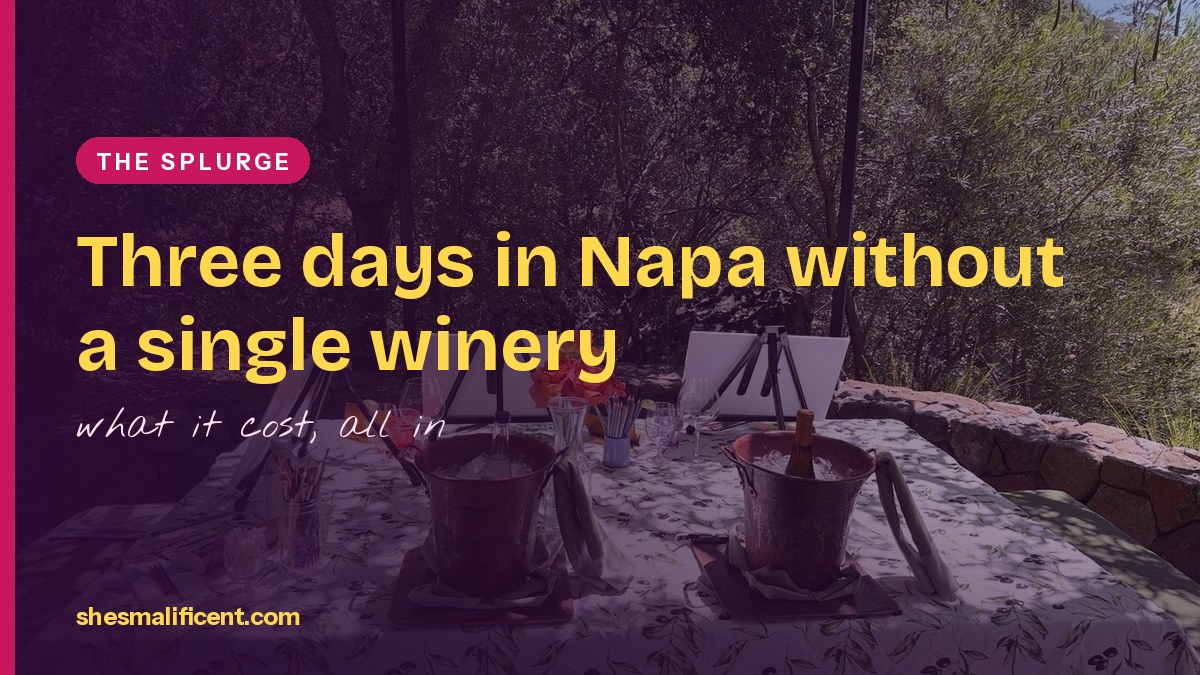
- A picnic and painting class, which was the best thing we did all trip
- Yountville — walked it, window shopped it, ate
- The spa
- One nice dinner at the hotel restaurant
- A lot of sitting by the pool


If you take one thing from this post: the non-wine version of Napa is a real trip. You don’t have to earn your stay there by drinking.
What was genuinely worth it: the room
The hotel is the splurge and the hotel is the thing.
The room was enormous. The amenities were included and actually good — I’m talking about the kind of bathtub you plan an evening around. When you’re paying resort money, this is the part that has to deliver, and it did.

What wasn’t worth it: the restaurant
Acacia House, the restaurant at the hotel, is very highly regarded.
It was fine.
Not life-changing. Good, not memorable, and priced like it should have been memorable. I’m aware I’m in the minority here and people rave about it, so to each their own — but you asked me to be honest, and the honest version is that the dinner is the line item I’d cut.

The wine, though, was very good. Which brings me to the only actual money tip in this whole post.
The free bottle rule
They give you a bottle of wine.
Take it, and save it for later. Don’t open it there, don’t buy a second one, and especially don’t buy a second one if you aren’t heavy drinkers. That’s how a nice included perk turns into a $90 impulse you drink half of.
This is the whole financial-self-care thing in miniature: the free thing is only free if you don’t spend money chasing more of it.
The surprising part
They’ll rent you one of their luxury cars to drive around the valley.
My husband loved that. I did not, particularly. Which is its own useful travel lesson — in a place this expensive, let each person pick one thing that’s just theirs, and don’t make the other one pretend.
The spa I’d give a 6 out of 10. It was genuinely nice, they bring you a bowl of fruit, they’ll cater food to you. Was it life-changing? No. If your budget is tight, this is the second thing I’d cut.
The girls trip math nobody does
Here’s the part I didn’t expect to be writing.
The room was so spacious that it would comfortably work for four people.
Now, be careful with that math, because I was. My $7,000 was two people doing everything — the room, but also spa, dinners, the car. Split a room four ways and the room gets dramatically cheaper. The spa and the dinners don’t; those stay whatever they are per person.
But the room is the biggest line on the bill. That’s the one worth splitting.
So if you’ve been looking at a place like this and quietly closing the tab: run the number with three friends in it before you decide you can’t. That’s not me telling you it’s cheap. It isn’t. It’s me telling you that “out of reach” and “out of reach for one person” are two different sentences.
Would I go back?
Seven, maybe eight out of ten.
The resort earns its money. The food didn’t. The painting class is the thing I’d tell a friend to book first, which is not a sentence I expected to write about Napa.
Save for it, go for a reason, and skip the wineries if you want to. Nobody’s checking.
If you’re planning this trip
- Three days is right. Long enough to stop rushing, short enough that the total stays in range.
- Book the non-wine thing. The painting class outperformed everything.
- The room is the splurge. Let it be the splurge. Cut elsewhere.
- Take the free bottle home. Don’t buy a second.
- Yountville for the walk, not just the restaurants.
- Run the four-way split before you write it off.
Before you book anything with a number like this attached to it, run the money checklist below. A trip you saved for feels completely different from a trip you’re still paying for in March. #bigsisenergy